

Warehouse Management Process Flow: The Complete 7-Stage Guide
From dock to dispatch — every stage of the warehouse workflow, the KPIs that matter at each step, and how to eliminate the bottlenecks that cost you time and money.
In This Guide
The 7-Stage Process Flow
Every warehouse — whether a 5,000 sq ft startup fulfillment center or a 500,000 sq ft distribution hub — runs on the same fundamental sequence. Goods arrive, they are stored, orders are fulfilled, and shipments leave. The difference between a warehouse that loses money and one that prints it lies entirely in how well each stage is executed and how seamlessly they connect.
Direct labor across these seven stages represents 50–70% of warehouse operating expenses. Picking alone consumes 55% of total labor hours. Understanding where time and money are spent at each stage is the first step toward eliminating waste.
Stage 1: Receiving
Receiving is where the entire warehouse flow begins — and where the most consequential errors are made. A pallet miscounted at the dock becomes an inventory discrepancy in storage, a wrong pick in fulfillment, and a customer complaint at delivery. Getting receiving right is not optional; it is the foundation everything else stands on.
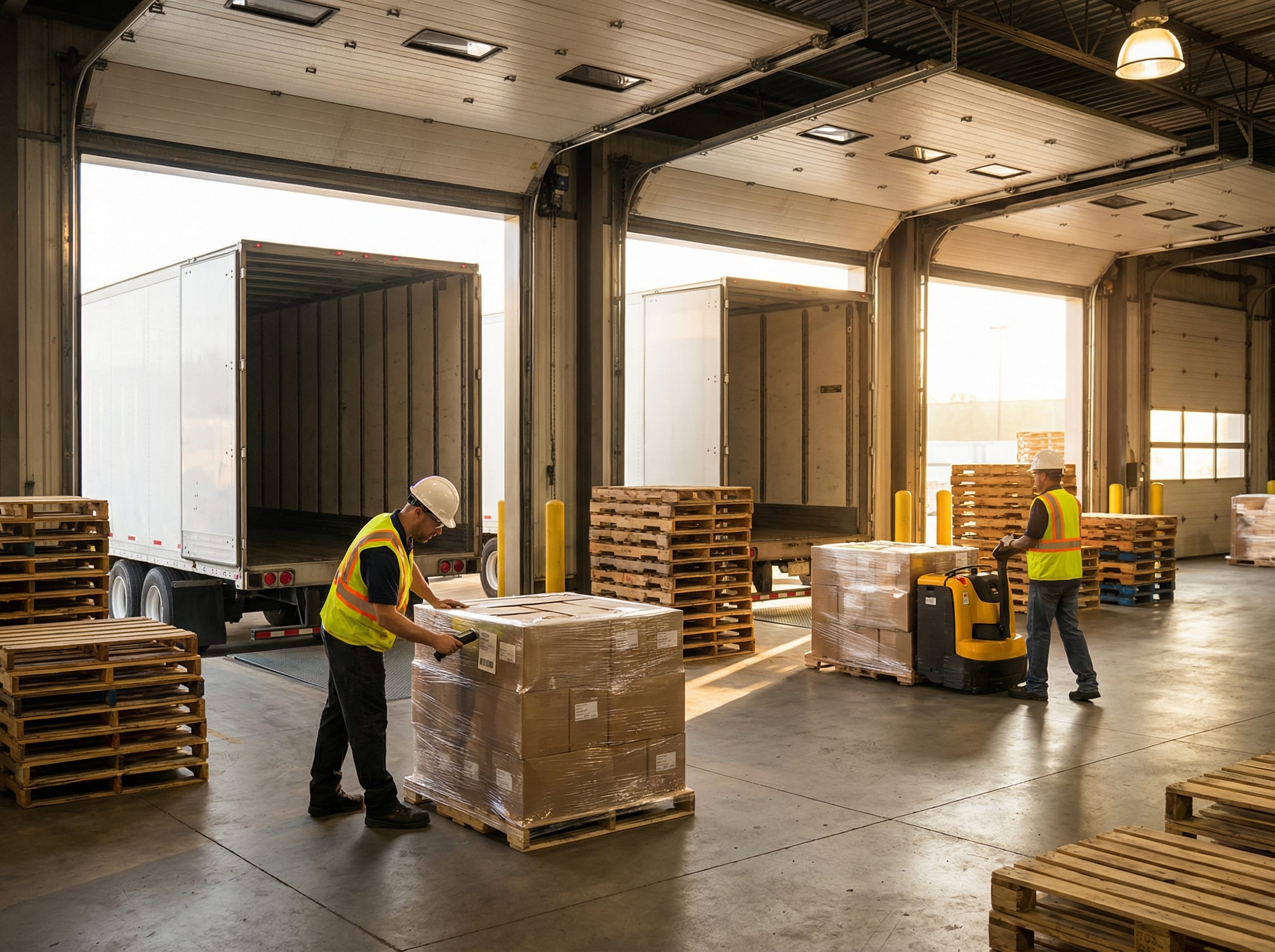
The Receiving Workflow
Step 1: Trucks arrive per dock scheduling appointments. ASN (Advanced Shipping Notice) data tells the team exactly what is coming, how many cartons, and which SKUs.
Step 2: Unload, count, and inspect for damage. Scan every item into the WMS via barcode or RFID.
Step 3: Sort by SKU/batch and stage for putaway. Cross-dock eligible items route directly to outbound.
Why ASN Matters
- Pre-allocates storage locations before goods arrive
- Stages appropriate labor and equipment per time slot
- Enables cross-docking decisions in advance
- Reduces dock-to-stock time by over 50%
- RFID scanning at receiving reduces inventory discrepancies by up to 80%
Stage 2: Putaway
Putaway is the bridge between receiving and storage. It determines where every item lives in the warehouse — and a bad putaway decision creates a ripple effect that slows every subsequent stage. The goal is to place items in locations that minimize future travel time while maximizing space utilization.
Three Putaway Strategies
- Directed putaway: WMS assigns optimal locations based on velocity, cube, weight, and demand forecast. High-turn items go near picking zones (the “hot zone”). This is the gold standard.
- Random putaway: Items go to any available location; relies on WMS tracking. Maximizes space utilization but increases travel time for pickers.
- Fixed putaway: Each SKU has a permanent home location. Simple to manage but wastes space when inventory fluctuates seasonally.
The optimization principle: Slotting — the practice of assigning products to locations based on velocity and co-occurrence — reduces picking walk distances by 15–30% and improves capacity utilization by 20–40%. Integrating ABC classification with real-time demand forecasting reduces picker travel by 27% on average. High-performing operations recalibrate slotting weekly or monthly.
Stage 3: Storage & Inventory
Storage is not just about putting things on shelves. It is the continuous management of what you have, where it is, and how fast it moves. The difference between a warehouse running at 70% accuracy and one at 99.9% comes down to three things: slotting, counting methods, and stock rotation discipline.
- ~20% A-items: Drive 80% of picks. Premium locations near packing.
- ~30% B-items: Secondary locations, moderate accessibility.
- ~50% C-items: Remote zones, upper/lower rack levels.
Cycle Counting vs. Physical Inventory
Cycle counting audits small subsets of inventory regularly without disrupting operations. It achieves 98% accuracy compared to traditional physical inventory at just 68% (WERC 2025). The best practice: count A-items weekly, B-items monthly, C-items quarterly.
FIFO, LIFO, FEFO
FIFO (First-In, First-Out) is standard for general merchandise. FEFO (First-Expired, First-Out) is mandatory for food, pharma, and cosmetics — prioritizing earliest expiry regardless of receipt date. Many operations run FEFO for date-coded SKUs and FIFO for everything else. Best-in-class inventory accuracy: 99.888% (WERC top 20%).
Stage 4: Picking
Picking is where the money is — and where most of it is wasted. It consumes 55% of warehouse labor hours and over 35% of warehouses experience a picking error rate above 1%. Workers in non-automated warehouses spend up to 60% of their time simply walking between locations. The right picking method can transform this bottleneck into a competitive advantage.
Single Order Picking
One picker, one order at a time. Simple and accurate, but low throughput. Best for high-value, complex orders where accuracy outweighs speed.
80–120 picks/hr (manual baseline)Batch Picking
One picker handles multiple orders in a single route through the warehouse. Dramatically reduces travel time for compact goods with frequent SKU overlap.
20–40% productivity improvement over singleWave Picking
Orders grouped into time-based waves aligned with carrier pickup cutoffs. Optimizes labor allocation and ensures shipments hit carrier windows.
Best for: high-volume DCs with scheduled cutoffsZone Picking
Each picker works within a defined zone; orders pass zone-to-zone. Reduces travel, increases specialization, and scales linearly with headcount.
Best for: large warehouses with many SKUsGoods-to-Person (GTP)
Automated shuttles or AMRs bring inventory to stationary pickers. Eliminates up to 60% of walking time and triples picking speed.
200–300% productivity gain; 12–18 month ROI
Stage 5: Packing
Packing is the last quality gate before an order leaves the warehouse. It is where picking errors get caught, dimensional weight gets calculated for shipping cost optimization, and the customer’s unboxing experience gets determined. A well-designed packing station pays for itself in reduced returns and shipping overcharges.
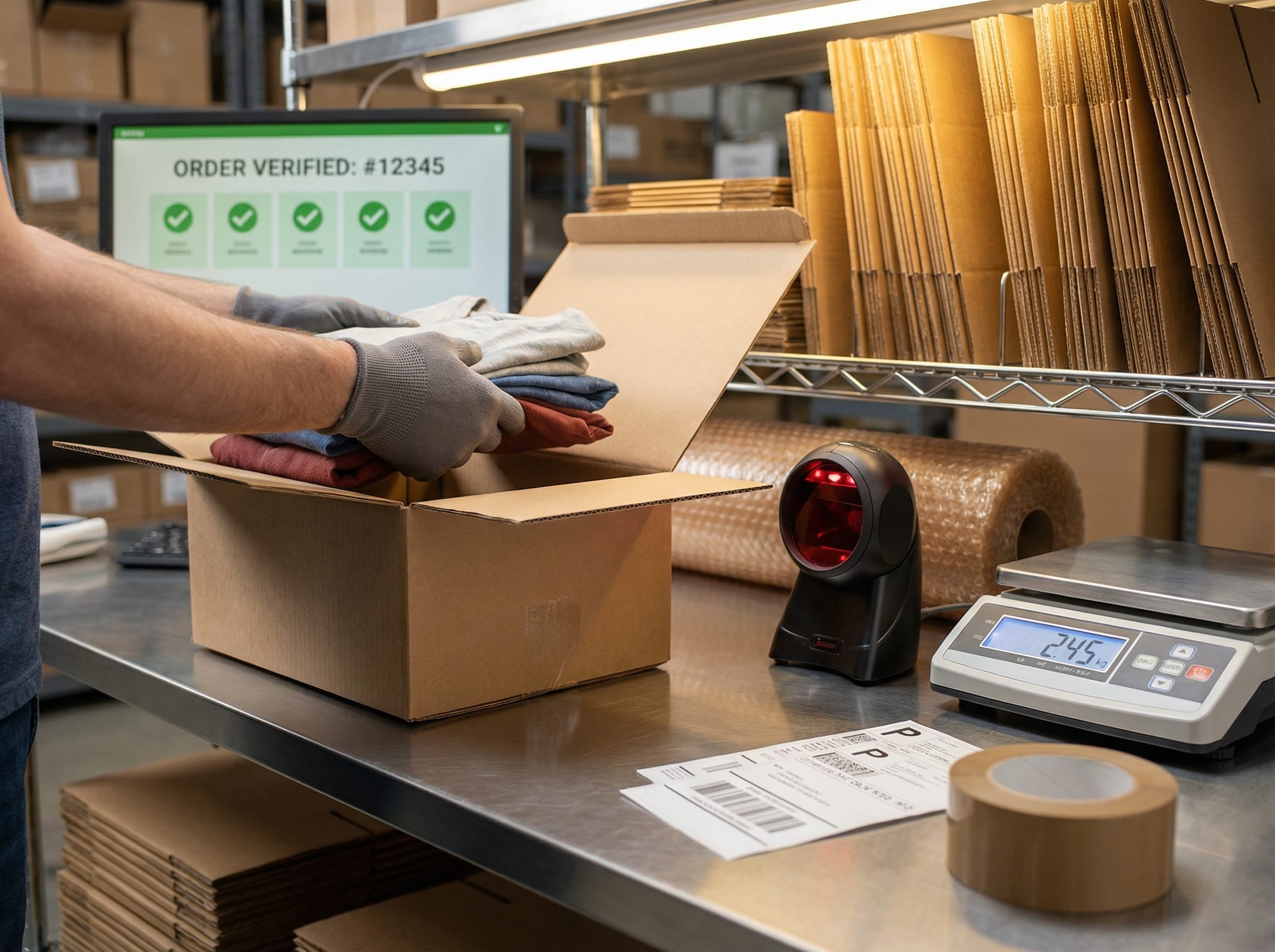
The packing workflow: barcode scan to validate every item against the order, weigh to verify quantity and calculate dimensional weight, pack with appropriate materials, and label with auto-generated shipping labels. A desktop barcode scanner at the packing station that forces validation before the box can be sealed catches errors that would otherwise cost $100+ per mis-pick in returns, re-shipping, and customer service time.
Stage 6: Shipping
Shipping is where warehouse operations meet the customer. Packed orders are sorted by carrier, manifested, loaded onto outbound vehicles, and dispatched with tracking information. The margin between an on-time delivery and a late one is often decided in the last 30 minutes of dock management.
The shipping workflow follows five steps: carrier selection (rule-based logic auto-selects lowest-cost or fastest carrier based on destination, weight, and SLA), manifest generation, outbound dock scheduling aligned with carrier pickup windows, sequenced loading based on delivery route, and electronic proof of delivery with signature capture.
“Only 86% of orders are delivered on time — meaning 14% experience delays. Customer expected delivery speed has dropped from 5.7 days to 2.5 days, projected to reach 1.5 days within five years. Nearly 50% of online orders are abandoned if estimated delivery exceeds 6 days.”
— E-Commerce Delivery Benchmark Data, 2025–2026Wave planning is the key: Aligning pick waves with carrier cutoff times ensures orders are packed and staged before the truck arrives. Without this alignment, you either miss the carrier window (delaying delivery by a full day) or hold the truck (incurring detention charges). Best-in-class on-time shipment rate: 99.5%+.
Stage 7: Returns
Returns are the stage most warehouses treat as an afterthought — and the one that costs the most when neglected. E-commerce return rates reach 30%, and handling each return costs $20–$30. The global reverse logistics market hit $711 billion in 2025. This is not a back-office nuisance; it is a major operational function.
The RMA Workflow
A structured returns process follows eight steps: customer initiates return → RMA issued with return label → item shipped back → received and scanned against RMA → inspection and grading (A-grade restock, B-grade refurbish, C-grade liquidate/dispose) → disposition executed → refund/exchange processed → analytics on return reasons.
Target: Process returns within 48 hours of receipt. Integrate the RMA system with your storefront, OMS, WMS, ERP, and helpdesk so information flows automatically instead of being re-keyed at each stage.
How WMS Orchestrates It All
The Warehouse Management System is the central nervous system that directs every stage: validating ASNs at receiving, calculating optimal putaway locations, managing bin addresses in storage, generating optimized pick routes, validating orders at packing, selecting carriers at shipping, and directing the RMA workflow for returns.
Common Bottlenecks & Fixes
Dock congestion: Poor scheduling with no ASN → implement dock appointments + ASN compliance program.
Slow putaway: No directed rules → enable WMS-directed putaway with velocity-based slotting.
Picking delays: Long travel distances → re-slot based on ABC analysis; consider GTP automation.
Packing errors: Manual QC → add barcode validation at every pack station.
Shipping delays: Missed carrier cutoffs → wave planning aligned with carrier schedules.

WMS-driven labor management alone can reduce labor costs by 15–30% through intelligent scheduling, increase throughput during peak without extra headcount, and lower overtime through precise task estimation. In the UAE, operations have seen order-to-delivery time drop from 4–6 days to 2–3 hours after WMS implementation.
Key Takeaways
What You Need to Remember
- The 7-stage flow — Receiving, Putaway, Storage, Picking, Packing, Shipping, Returns — is universal. Every warehouse runs on this sequence.
- Labor is 50–70% of warehouse cost. Picking alone consumes 55% of labor hours. Optimize picking first for maximum ROI.
- ASN utilization reduces dock-to-stock time by over 50%. Best-in-class target: under 3 hours.
- Slotting optimization cuts pick path distances by 15–30% and improves capacity by 20–40%. Recalibrate ABC classifications weekly.
- Cycle counting achieves 98% accuracy vs. 68% for physical inventory (WERC). Count A-items weekly, B monthly, C quarterly.
- Goods-to-Person automation delivers 200–300% productivity gains with 12–18 month ROI. Workers spend 60% less time walking.
- E-commerce returns hit 30% and cost $20–$30 each. Process within 48 hours. 84% of customers won’t return after a bad experience.
- WMS-driven labor management reduces costs by 15–30%. UAE operations have compressed order-to-delivery from days to hours.
Frequently Asked Questions
Let's talk scale.
Whether you're looking to optimize delivery, centralize operations, or unlock new revenue — Axiom X is your growth partner.
Our Headquarters
UAE